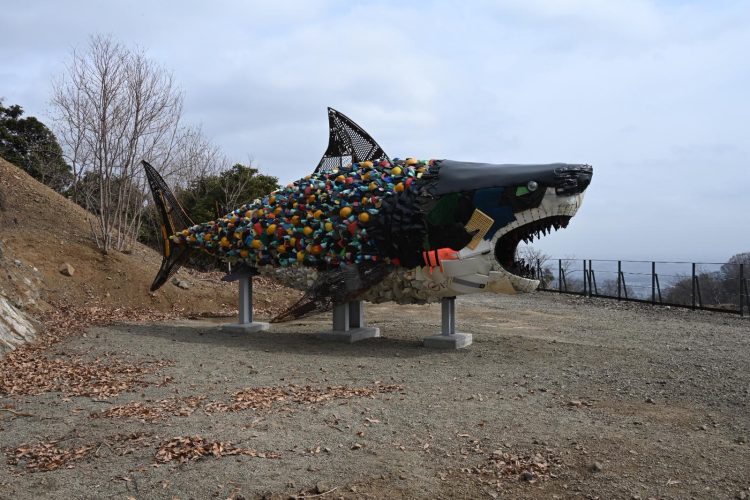
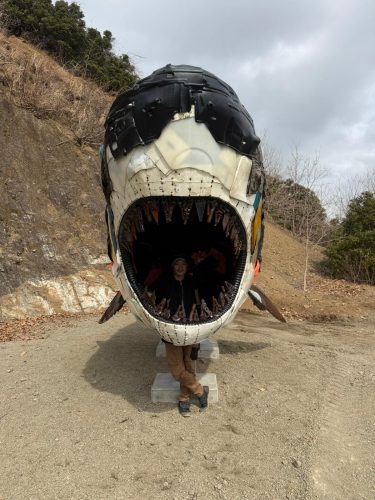
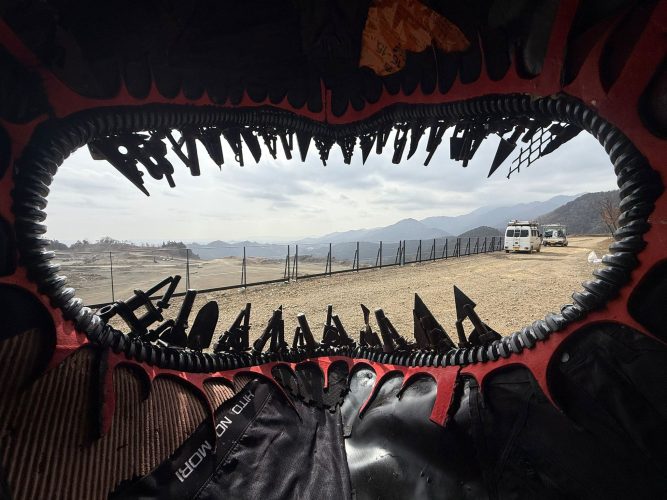
YUKARI ART is pleased to announce that Yodogawa Technique's latest public artwork 9 meter long "Kegon Forest's Megalodon" was completed on the 25th of February,2026. This is the artist's largest sculpture to date.
Commissioned by Hito no Mori Corporation, it is installed atop a mountain within the company's Kegon Quarry (Iiyama, Atsugi City, Kanagawa Prefecture).
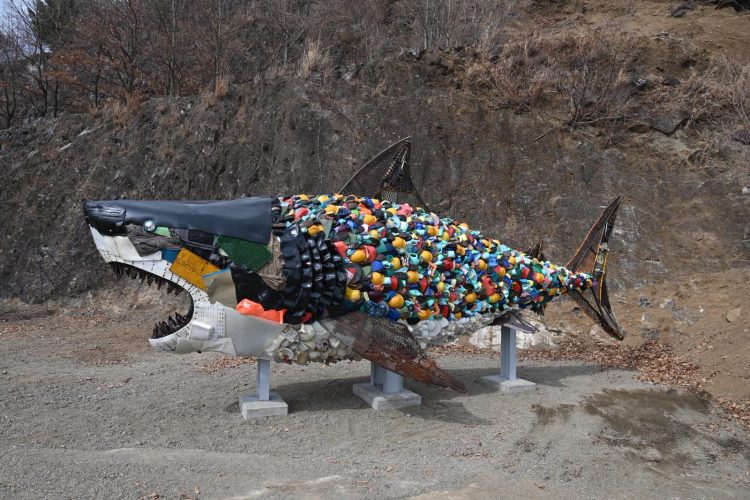
The primary materials are waste items from the factory—helmets, boots, scrap iron etc along with trash collected by the artist, his assistants and the company employees, on the Izu Peninsula. Trash gathered by the company's employees from the Sagami River, which holds deep ties to the company, is also incorporated.
During his first inspection of the Kegon Factory, Yodogawa Technique discovered fossils of the bivalve “Kanaharanishiki” within the quarry. This led him to the realization that the mountain housing the factory had risen from the sea. From this insight, he developed the idea and decided to use the extinct ancient shark, the “Megalodon,” as the motif for his work.
It is deeply moving that, after about a year and a half from conception and with the cooperation of many people, we were able to create the largest work in the artist's history. We would like to take this opportunity to express our heartfelt gratitude to everyone involved and hope that “Kegon Forest's Megolodon” will become a work loved by many.
Please note that the Kegon Factory is not open to the public except during events. If you wish to view the artwork, please contact us via our Contact form.
Hito no Mori Corporation's website:https://hitonomoricorp.jp
Biography of Yodogawa Technique:https://yukari-art.jp/en/artists/yodogawa-technique
The following is reprinted from the press release by Hito no Mori Corporation
“ART Connecting Waste and the Ancient Sea to the Future.”
ART de Upcycle Project “Kegon Forest's Megalodon”
Hito no Mori Corporation launched the ART de Upcycle Project “Kegon Forest's Megalodon” in August 2025. This project uses materials destined for disposal—such as work helmets, boots, workwear, and factory waste—to create new value and narratives through the power of art. The work has now been completed and is ready for its unveiling.
This project aims to give new life and purpose to waste materials while simultaneously visualizing the history, culture, and memories dormant within the land through ART, etching them into people's memories.
Completion
25th of February,2026
Materials
Framework/Steel
Surface/Various waste collected from Kegon Factory and the Izu Peninsula, waste collected from the Sagami River
About the artwork
Breathing new life into “waste” destined for disposal,
visualizing the timeless history buried in this land through the power of ART.
ART de Upcycle Project
“Megladon of Kegon Forest”
We wish to grant new life and purpose to objects that have fulfilled their role and face disposal,
through the sensibilities and skills of Yodogawa Technique.
His creative process begins with researching the site and engaging in dialogue with the objects themselves,
as part of his work to visualize the history, culture, and stories latent within the place and region through ART,
etching them into people's memories.
The resulting works radiate an unassuming, carefree energy, ever imposing, yet delivering a certain sense of wonder and surprise to viewers.
As the selected artist for an art-based upcycling project utilizing discarded helmets, boots, work clothes, and more,
Yodogawa Technique first visited the Kegon Factory and encountered fossils of the bivalve shellfish, Kanehara Nishiki.From there, the journey of exploring by Yodogawa Technique began.
Seeking a symbol for this land born from the sea's uplift,
he got to reach the extinct shark “Megalodon,”which lived from the Early Miocene to the Pliocene epoch,
approximately 23 million to 3.6 million years ago.That was in the summer of 2025.
Although his initial presentation left us utterly stunned,
it quickly transformed into joy and a sense of mission: We must make this happen!
Through art, we aim to give new value, purpose, and life to things that have fulfilled their role and are destined for disposal. Beyond sustainability, it is said that regeneration—actively restoring and improving natural environments and societies—is becoming the mainstream. This project stands as a symbol of the upcycling and circular economy
so desperately needed today.
Furthermore, through this artwork, we can contemplate the history and culture of this land from thousands, even millions of years ago. It goes without saying that this is an ART piece that captures the interest and admiration of diverse audiences.
The following are Yodogawa Technique's words from the presentation:
The Misaka Mountains, Tanzawa Mountains, and Izu Peninsula, carried by the Philippine Sea Plate, slowly drifted from the southern seas. They collided with the Japanese archipelago, causing the seabed to rise, forming mountains and land that now lie beneath our feet.
This work attempts to form a giant shark, the Megalodon, using discarded work tools like boots and helmets from that place that was once sea, along with marine debris washed ashore on the beaches of the Izu Peninsula.
The giant creature that once swam in this sea and the human hands now digging into its strata overlap within a single space.